
Bohemia Historical Society
The Jan Hus Monument
A Symbol of Independence — the first standalone Hus statue in the world
Location: Bohemia Union Cemetery (Church Street) • Dedicated: September 26, 1893 • Material: Vermont Granite

c. 1369–1415
Who Was Jan Hus?
Jan Hus (c. 1369–1415) was a Czech priest and the rector of Charles University in Prague who campaigned against the moral failings of the clergy and the sale of indulgences. His teachings were heavily influenced by John Wycliffe and anticipated the Protestant Reformation by a century. The core of his message was the concept of “Pravda Vítězí” or “Truth Prevails,” a motto that would later be inscribed on monuments globally and serve as a rallying cry for Czech nationalists.
The symbolic importance of Hus to the Bohemia, New York, settlers was rooted in his martyrdom. After being promised safe passage to the Council of Constance, he was tried for heresy and burned at the stake on July 6, 1415. This act of betrayal by the ecclesiastical authorities turned Hus into a symbol of Czech national identity and resistance against the broader Austro-Hungarian Empire, which ruled the Czech lands from 1526 until 1918. For the immigrants of the 1850s, Hus represented the “First in the World” spirit of independence that they sought to replicate in the United States.
“Hus” or “Jus”?
Variations in Nomenclature and Artistic Legacy
“Jan Jus” highlights a fascinating linguistic and archival thread within the Bohemia Historical Society’s records. While “Hus” is the standard spelling, “Jus” appears in certain artistic contexts, most notably in the work of the renowned Czech artist Alphonse Mucha. Mucha, who was a central figure in the Czech national revival, created a massive painting titled “Master John Juss Preaching in the Bethlehem Chapel” as part of his “Epic of the Slavs” cycle. Photographic archives show Mucha himself posing as “Jan Jus” to use as a reference for his paintings, suggesting that the “Jus” spelling may have been an intentional stylistic or archaic variant used by nationalists to emphasize a specific phonetic or historical lineage. In local Bohemia, New York history, the terms are used interchangeably to describe the same monument in the Union Cemetery.
1855
The Migration and the Birth of a Hamlet
The community of Bohemia was established in 1855 by three core Czech families who were part of a larger wave of immigrants fleeing the restrictive atmosphere of the Habsburg monarchy. These settlers brought with them a “fierce desire for religious and intellectual liberty.” Many were “Freethinkers” belonging to the Volné Myšlenky movement, a secularist and rationalist group that rejected the authority of the Catholic Church and the state.
The early geography of the settlement was rugged, then known as part of “Lakeland.” The transition from the name “Tabor” — a reference to the radical Hussite stronghold in Bohemia, Europe — to “Bohemia” reflects the community’s deepening commitment to their ethnic roots while integrating into the American landscape.
1885
The Union Cemetery: A Sanctuary for Freethinkers
The catalyst for the Jan Hus statue was the founding of the Bohemia Union Cemetery in 1885. In the nineteenth century, the local Catholic Church often denied burial to individuals who were not in good standing, such as Masons, members of benevolent societies like the CSPS, or those who identified as Freethinkers. This exclusionary practice created a crisis for the immigrant community, who required a place where they could “rest in peace, watched over by their hero, Jan Hus.”
The cemetery was established on Church Street as a non-sectarian ground open to all residents regardless of creed. This “declaration of independence” from church dogma allowed the community to center their most sacred space around the figure of Hus, who was viewed not as a saint in the traditional sense, but as a martyr for the right to follow one’s conscience.
1889–1893
The Monument Project
The decision to erect a statue was a massive financial and logistical commitment for a population of fewer than 1,000 people. The committee, chaired by Joseph Jedlicka, worked for four years to raise the necessary funds. This era was marked by the “Golden Age of Cigars” in Bohemia, where local factories provided the economic stability needed to support such a cultural project.
The statue was carved from high-quality Vermont Granite, a material chosen for its durability and somber elegance. The monument stands twelve feet high and is positioned atop a mound specifically created for the purpose, ensuring it serves as the focal point of the cemetery. The iconography of the statue is deeply symbolic:
The Clerical Robes
Represent Hus’s authority as a scholar and rector of Charles University.
The Chalice
The most critical detail: it represents the Utraquist demand that the laity receive communion in both kinds (bread and wine), a radical stance for equality in the fifteenth century.
The Posture
Historical accounts describe Hus as standing in a position of “defiance,” looking forward with conviction, reflecting his refusal to recant his beliefs.
Funding the Monument
The funding was entirely voluntary, demonstrating the community’s collective will.
Total recorded cost: $1,037.36–$1,400.00 — equivalent to several years of wages for a typical laborer in 1893.
CSPS Benevolent Society: $327.00 — contribution from the lodge and the Unity of Bohemian Ladies.
Local resident collections: ~$710.36 — raised through small, individual donations from the families of Bohemia.
September 26, 1893
The Dedication Ceremony
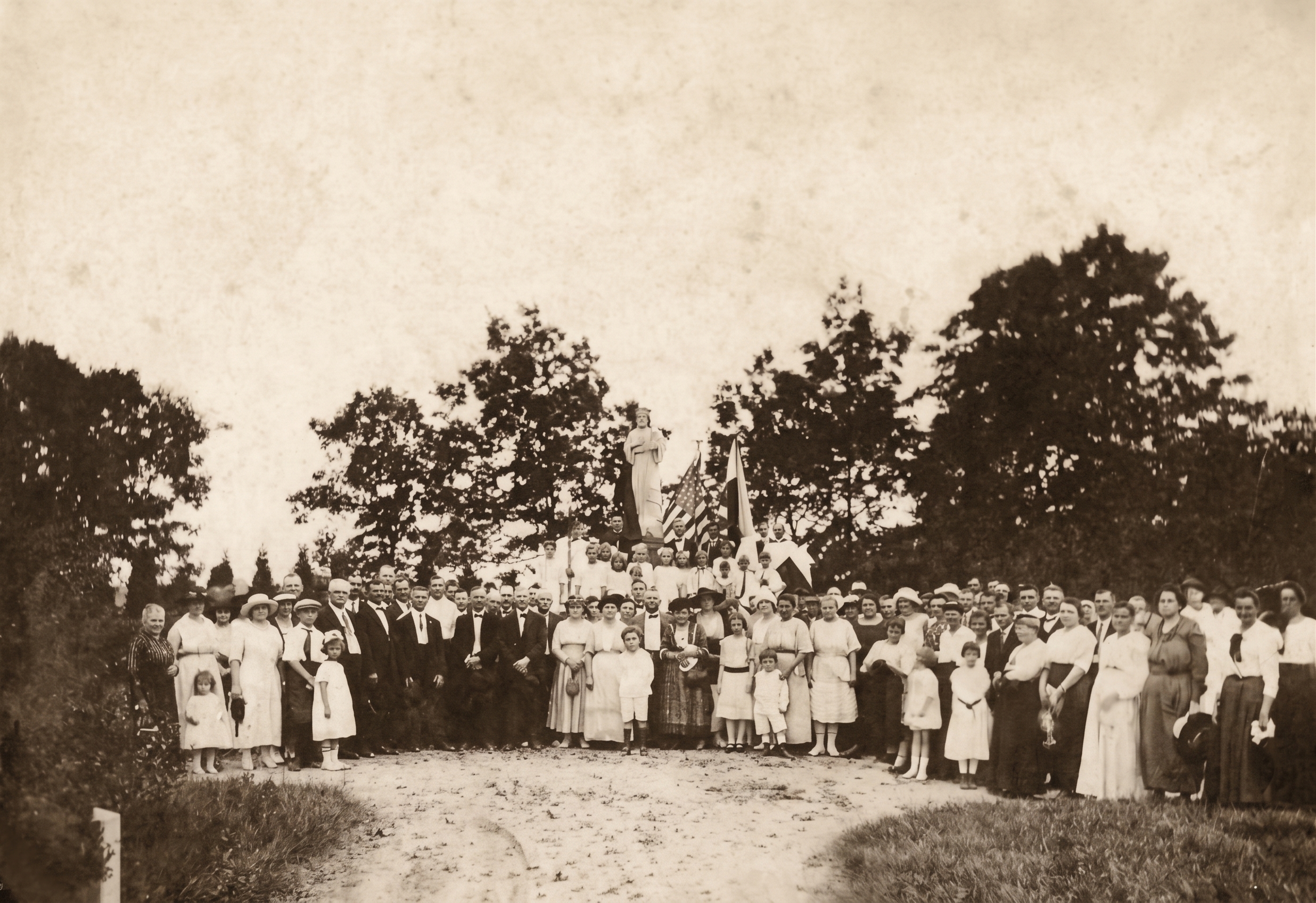
The unveiling of the Jan Hus statue was arguably the most significant social and ethnic gathering in the history of Long Island’s Czech community. The village, which normally maintained a quiet, rural character, was transformed into a bustling center of “ethnic pride.”
Logistical Achievement and the LIRR
The logistical feat of transporting thousands of people to a remote hamlet in 1893 cannot be overstated. Special trains were chartered to run from Long Island City to the Sayville station, carrying Czech immigrants from Manhattan, Queens, and New Jersey. Historical estimates suggest the crowd reached between 3,000 and 4,000 people — effectively tripling or quadrupling the local population for the day.
The procession from the Sayville train station to the cemetery on Church Street was a grand display of heritage. Led by Joseph Jedlicka as the marshal, the parade featured bands, flags of both the United States and the Czech lands, and the ornate banners of the various Cesko-Slovansky Podporujici Spolek (CSPS) lodges. Arches of flowers were erected across the streets, and every homestead was decorated in red, white, and blue, alongside the colors of the old country.
The Global Context of 1893
It is vital to recognize the historical timing of this dedication. In 1893, the world was focused on the World’s Columbian Exposition in Chicago, an event that celebrated modern progress. Simultaneously, in the Czech lands of the Austro-Hungarian Empire, nationalists were protesting German control over Prague. By erecting a statue of Hus in New York during this exact year, the Bohemia settlers were making a global statement that the “Truth” Hus died for was now thriving in the New World, even while suppressed in the Old.
1868 — Worms, Germany: Hus is a secondary figure in the Luther Monument.
1893 — Bohemia, NY: First standalone Hus statue in the world.
1904 — Protivin, Iowa: unveiling of the second standalone statue in North America.
1915 — Prague, Czech Republic: Old Town Square memorial unveiled for the 500th anniversary.

1977
Crisis and Restoration: The 1977 Vandalism
For nearly eighty-five years, the statue stood undisturbed as a silent sentinel over the Union Cemetery. However, in July 1977, the community faced a profound challenge when the monument was targeted by vandals. On July 5 or 6, shortly after the July 4th holiday weekend, the 800-pound stone figure was toppled from its pedestal.
The investigation revealed that the vandals had stolen a rope from the flagpole at the John Pearl Elementary School. They looped this rope around the neck of the statue and used their combined weight to leverage the granite figure off its base. A spokeswoman for the Cemetery Association noted that it would have taken at least three people to move a stone of that magnitude. The toppling of the statue was seen as more than a simple act of property damage; it was an assault on the community’s ancestral memory and the “First in the World” legacy they had meticulously guarded.
The subsequent restoration of the statue became a rallying point for the Bohemia Historical Society. The repair work was not merely about resetting the stone but about reasserting the importance of the Jan Hus legacy in a modern, rapidly changing Long Island.
September 26, 1993
The 1993 Centennial and Cultural Stewardship
On September 26, 1993 — exactly 100 years to the day after the original unveiling — the community gathered once again to rededicate the monument. This centennial celebration served as a bridge between the nineteenth-century pioneers and the contemporary residents of Bohemia.
The Shift in Religious Context
A notable detail of the 1993 ceremony was the weather. Due to rain, the main proceedings were moved inside St. John Nepomucene Church. This was a significant historical irony: a statue originally erected to protest the exclusionary practices of the nineteenth-century church was now being celebrated within a Catholic sanctuary. This shift underscores the evolution of the Bohemia community from a collection of divided factions (Catholics vs. Freethinkers) into a unified group dedicated to preserving their shared ethnic heritage.
The 1993 Time Capsule
To ensure that the history of the 1893 pioneers remained accessible to future generations, a time capsule was buried at the base of the monument during the centennial. This capsule contains documents, artifacts, and stories from the twentieth-century residents of Bohemia, providing a link between the era of cigar factories and the modern suburban period.