
Bohemia Historical Society
Cervenka’s Market
From a $100 schoolhouse to the corner store that fed a village


1903
The $100 Schoolhouse
The commercial history of the Cervenka family in Bohemia began with a remarkable act of architectural and logistical ingenuity. In the late 19th century, education was a central pillar of the community’s growth, and by 1867, a small one-room schoolhouse had been constructed to serve the district. However, by 1903, the village had grown so rapidly that a larger, four-room school was commissioned and dedicated on July 3rd of that year. This transition left the original 1867 structure redundant, leading the town to put it up for auction.
Frank Cervenka, a man of profound foresight and resourcefulness, saw an opportunity where others saw an old building. He placed the winning bid of exactly $100.00 for the schoolhouse. The purchase, however, came with a daunting stipulation: the building had to be entirely moved off the school property within ten days of the sale. Failure to meet this deadline would result in the forfeiture of the building or its destruction. Using local labor and the primitive equipment available at the turn of the century, Frank successfully orchestrated the move of the entire wooden structure to the corner of Locust Avenue and Church Street.
This move was more than a simple property transfer; it was a physical manifestation of the community’s ability to repurpose its history to serve its future. Frank converted the former classroom into the town’s first Cervenka grocery store, transforming a site of learning into a site of commerce. This initial establishment provided the essential foundation for what would become the most vital intersection in the hamlet, serving as a hub for farmers and industrial workers alike who needed a central location to purchase their daily bread and household necessities.

c. 1905–1910
Cyril Cervenka: The Visionary of the Edwardian Era
While Frank Cervenka established the business, it was his son, Cyril Cervenka, who would elevate the market into a regional landmark. Born in 1882, Cyril was part of a pivotal “transitional” generation in Bohemia — the children of the original settlers who were equally comfortable in the Czech traditions of their parents and the rapidly modernizing American culture. A rare portrait from the Edwardian period (c. 1905–1910) captures Cyril in his twenties, embodying the sophistication of the era with a high stiff collar and club tie. This image reflects a young man prepared to lead Bohemia into the 20th century with a modern business sense that matched the evolving needs of the village.
Cyril understood that as Bohemia transitioned from a rugged farming outpost into a bustling village of specialized craftsmen, the simple general store would need to evolve. The town’s residents were no longer just subsistence farmers; they were skilled cigar rollers and pearl-button makers who earned steady wages and demanded higher-quality goods and services. Cyril’s vision for the future of the market culminated in the decision to replace the old wooden schoolhouse with a permanent, state-of-the-art brick structure.

1923
The 1923 Modernization: Brick, Mortar, and Technology
By 1923, the grocery business had outgrown the repurposed schoolhouse. To execute his vision for a modern market, Cyril Cervenka turned to the most respected builders in the region: Benedict and Swanda. This partnership was symbolically significant, as it linked the Cervenka legacy to the founding families and the premier craftsmen of Bohemia. The Swanda family was renowned for their mastery of masonry, and they were instrumental in replacing the town’s early wooden shelters with permanent, sophisticated brick commercial buildings.
The construction of the new Cervenka Market at the corner of Locust Avenue and Church Street was a watershed moment for the village. The resulting building was considered “state-of-the-art” for its time, featuring a technological luxury that set it apart from every other establishment in the area: a modern walk-in refrigerator. This innovation was transformative for the community’s diet and health. In an era when fresh meat and produce were difficult to store without spoilage, the walk-in refrigerator allowed the Cervenkas to stock a consistent supply of fresh perishables throughout the year. This was not merely a convenience; it was a significant advancement in the village’s standard of living, moving Bohemia away from a dependence on salted or preserved meats and seasonal produce.


Benedict & Swanda
The Architecture of a Master
The role of Benedict and Swanda in shaping the physical identity of Bohemia cannot be overstated. Their expert brickwork transformed the hamlet from a collection of rustic homesteads into a permanent hub of industry and commerce. Beyond the Cervenka Market, this firm was responsible for several of the most notable structures in the town’s history, including the CSA (Czechoslovak Society of America) Hall and the iconic Chateau La Boheme.
Winnie Benedict, a great-grandson of founder John Vavra, was a central figure in this architectural revolution. He owned a local lumber yard and collaborated with the Swandas to create buildings that reflected the village’s European heritage. For instance, the Chateau La Boheme (later known as the Normandie Inn) featured French Provincial style with castle-like turrets and a massive 500-year-old carved fireplace, demonstrating a level of architectural ambition that was rare for a small Long Island hamlet. The fact that the Cervenka family chose these same craftsmen for their market indicates the importance they placed on creating a building that would serve as a lasting landmark for the community.
The 1923 market was designed not just for utility, but for presence. Located at a critical crossroads, its brick façade signaled the stability and prosperity of the village. When the new brick building was completed, the original 1867 wooden schoolhouse did not disappear; in keeping with the town’s tradition of resourcefulness, it was sold and moved for a second time, finding a new home at Karshick Street and Smithtown Avenue. This ongoing “second life” of the original schoolhouse remains one of the most fascinating footnotes in the town’s structural history.
The General Store Era
The “Social Media” of the Floor
In its prime, Cervenka’s Market was more than just a place to buy groceries — it was a community hub that helped sustain the hamlet through its growth and hardest times. In the early 20th century, the market functioned as a true general store, supplying the village with every daily necessity. This included not just fresh produce and groceries, but also the agricultural essentials required by the many residents who maintained small-scale farms alongside their factory work. The store was a primary source for seed potatoes and chicken feed, ensuring that local farmers could maintain their livelihoods. Historical accounts and photographs depict Cyril and his son George inside an establishment that functioned as Bohemia’s early “supermarket,” offering a breadth of inventory that was unmatched in the region.
General stores like Cervenka’s and Bartik’s flourished not just as retail spaces but as the “social media” of the day. It was here that neighbors gathered to trade news, discuss town meetings, and maintain the personal connections that defined the small-town experience.
Cyril Cervenka himself became a familiar and beloved figure in this social landscape. He was often seen around town making deliveries in his signature green panel truck. This delivery service was vital for the elderly and those whose long hours in the cigar factories left little time for shopping. The sight of the green truck pulling up to a home was a symbol of the market’s dedication to personal service, a hallmark of the Cervenka family legacy.
The Great Depression
The “Little Book”: A Sanctuary of Social Credit
The true character of Cyril Cervenka and his market was revealed during the darkest years of the Great Depression. While the economic collapse devastated families across the country, the impact in Bohemia was particularly acute for those in the labor-intensive cigar and button industries. During this period, Cyril became a neighbor who looked out for his community in ways that transcended traditional business.
Behind the counter, Cyril kept a “little book.” This ledger was used to record the grocery bills of struggling families who were temporarily unable to pay. In an extraordinary display of trust and generosity, Cyril allowed these families to purchase the food they needed on credit, telling them to pay only when they were financially able. For many residents, this “little book” was the only thing standing between their families and hunger. This practice highlights the deep sense of ethnic and communal solidarity that defined Bohemia; the success of the market was intrinsically tied to the survival of the neighbors it served.
The impact of this generosity resonated for decades. Long-time residents remembered not just the goods they bought, but the personal connection and the safety net the Cervenka family provided during the town’s hardest times. This social capital was a defining feature of the “Grocer of Bohemia,” establishing a reputation for civic duty that would be passed down to the next generation.
World War II Era
Under the Royal Scarlet Sign
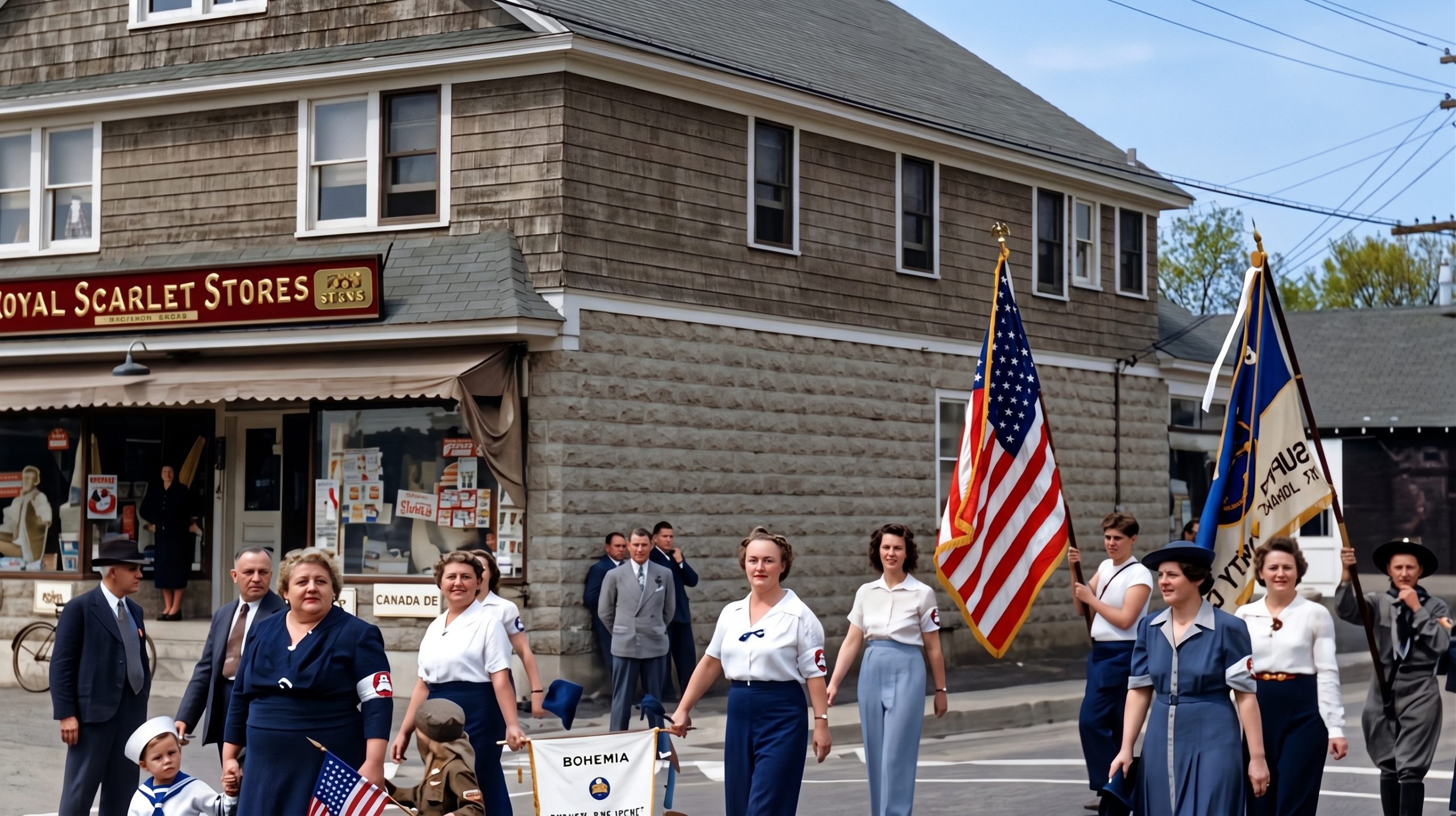
By the 1940s, a new name hung over the corner of Locust Avenue and Church Street. A photograph of a parade passing the market, likely taken during World War II, shows marchers wearing armbands and carrying a “Bohemia” banner with what appears to be the Civilian Defense emblem. Above the storefront behind them, a sign reads “Royal Scarlet Stores.”
Royal Scarlet was the house brand of R.C. Williams & Co., a New York City wholesale grocer whose trademark dated back to 1897. Independent grocers across the region, including stores in Massapequa Park and East Islip, put the name on their signs while staying locally owned. For a village market, the arrangement meant a big-city wholesaler’s full line of canned goods, juices, and household staples on its shelves. The sign out front carried a New York brand, but the counter behind it still belonged to the Cervenkas.
Today
From Market to Deli: The Continuity of the 1923 Structure
While the name on the sign eventually changed, the physical legacy of Cyril Cervenka’s 1923 vision remains a fixture of the neighborhood today. The original brick building constructed by Benedict and Swanda still stands as a testament to Bohemia’s enduring small-business history. After serving for decades as Cervenka’s Market and later as the Family Deli, the building continues to operate today as the Locust Avenue Deli.
The building’s endurance is a rare example of structural and functional continuity. While many other historic landmarks in Bohemia have been lost to fire or development — such as the original Chateau La Boheme or the first school buildings — the Cervenka building has survived. This survival is particularly poignant given the challenges faced by other historic sites; for example, the nearby St. John Nepomucene church was gutted by an electrical fire in 2012, although it was later restored.
The fact that the Locust Avenue Deli still serves the community from the same corner where Frank Cervenka once placed an old wooden schoolhouse provides a sense of historical anchor for the village. It remains a place where residents gather, shop, and share news, fulfilling the same basic human need for community and connection that the Cervenkas recognized over a century ago.

Bohemia Historical Society
Cervenka’s Market
From a $100 schoolhouse to the corner store that fed a village
1903
The $100 Schoolhouse
The commercial history of the Cervenka family in Bohemia began with a remarkable act of architectural and logistical ingenuity. In the late 19th century, education was a central pillar of the community’s growth, and by 1867, a small one-room schoolhouse had been constructed to serve the district. However, by 1903, the village had grown so rapidly that a larger, four-room school was commissioned and dedicated on July 3rd of that year. This transition left the original 1867 structure redundant, leading the town to put it up for auction.
Frank Cervenka, a man of profound foresight and resourcefulness, saw an opportunity where others saw an old building. He placed the winning bid of exactly $100.00 for the schoolhouse. The purchase, however, came with a daunting stipulation: the building had to be entirely moved off the school property within ten days of the sale. Failure to meet this deadline would result in the forfeiture of the building or its destruction. Using local labor and the primitive equipment available at the turn of the century, Frank successfully orchestrated the move of the entire wooden structure to the corner of Locust Avenue and Church Street.
This move was more than a simple property transfer; it was a physical manifestation of the community’s ability to repurpose its history to serve its future. Frank converted the former classroom into the town’s first Cervenka grocery store, transforming a site of learning into a site of commerce. This initial establishment provided the essential foundation for what would become the most vital intersection in the hamlet, serving as a hub for farmers and industrial workers alike who needed a central location to purchase their daily bread and household necessities.
c. 1905–1910
Cyril Cervenka: The Visionary of the Edwardian Era
While Frank Cervenka established the business, it was his son, Cyril Cervenka, who would elevate the market into a regional landmark. Born in 1882, Cyril was part of a pivotal “transitional” generation in Bohemia — the children of the original settlers who were equally comfortable in the Czech traditions of their parents and the rapidly modernizing American culture. A rare portrait from the Edwardian period (c. 1905–1910) captures Cyril in his twenties, embodying the sophistication of the era with a high stiff collar and club tie. This image reflects a young man prepared to lead Bohemia into the 20th century with a modern business sense that matched the evolving needs of the village.
Cyril understood that as Bohemia transitioned from a rugged farming outpost into a bustling village of specialized craftsmen, the simple general store would need to evolve. The town’s residents were no longer just subsistence farmers; they were skilled cigar rollers and pearl-button makers who earned steady wages and demanded higher-quality goods and services. Cyril’s vision for the future of the market culminated in the decision to replace the old wooden schoolhouse with a permanent, state-of-the-art brick structure.
1923
The 1923 Modernization: Brick, Mortar, and Technology
By 1923, the grocery business had outgrown the repurposed schoolhouse. To execute his vision for a modern market, Cyril Cervenka turned to the most respected builders in the region: Benedict and Swanda. This partnership was symbolically significant, as it linked the Cervenka legacy to the founding families and the premier craftsmen of Bohemia. The Swanda family was renowned for their mastery of masonry, and they were instrumental in replacing the town’s early wooden shelters with permanent, sophisticated brick commercial buildings.
The construction of the new Cervenka Market at the corner of Locust Avenue and Church Street was a watershed moment for the village. The resulting building was considered “state-of-the-art” for its time, featuring a technological luxury that set it apart from every other establishment in the area: a modern walk-in refrigerator. This innovation was transformative for the community’s diet and health. In an era when fresh meat and produce were difficult to store without spoilage, the walk-in refrigerator allowed the Cervenkas to stock a consistent supply of fresh perishables throughout the year. This was not merely a convenience; it was a significant advancement in the village’s standard of living, moving Bohemia away from a dependence on salted or preserved meats and seasonal produce.
Benedict & Swanda
The Architecture of a Master
The role of Benedict and Swanda in shaping the physical identity of Bohemia cannot be overstated. Their expert brickwork transformed the hamlet from a collection of rustic homesteads into a permanent hub of industry and commerce. Beyond the Cervenka Market, this firm was responsible for several of the most notable structures in the town’s history, including the CSA (Czechoslovak Society of America) Hall and the iconic Chateau La Boheme.
Winnie Benedict, a great-grandson of founder John Vavra, was a central figure in this architectural revolution. He owned a local lumber yard and collaborated with the Swandas to create buildings that reflected the village’s European heritage. For instance, the Chateau La Boheme (later known as the Normandie Inn) featured French Provincial style with castle-like turrets and a massive 500-year-old carved fireplace, demonstrating a level of architectural ambition that was rare for a small Long Island hamlet. The fact that the Cervenka family chose these same craftsmen for their market indicates the importance they placed on creating a building that would serve as a lasting landmark for the community.
The 1923 market was designed not just for utility, but for presence. Located at a critical crossroads, its brick façade signaled the stability and prosperity of the village. When the new brick building was completed, the original 1867 wooden schoolhouse did not disappear; in keeping with the town’s tradition of resourcefulness, it was sold and moved for a second time, finding a new home at Karshick Street and Smithtown Avenue. This ongoing “second life” of the original schoolhouse remains one of the most fascinating footnotes in the town’s structural history.
The General Store Era
The “Social Media” of the Floor
In its prime, Cervenka’s Market was more than just a place to buy groceries — it was a community hub that helped sustain the hamlet through its growth and hardest times. In the early 20th century, the market functioned as a true general store, supplying the village with every daily necessity. This included not just fresh produce and groceries, but also the agricultural essentials required by the many residents who maintained small-scale farms alongside their factory work. The store was a primary source for seed potatoes and chicken feed, ensuring that local farmers could maintain their livelihoods. Historical accounts and photographs depict Cyril and his son George inside an establishment that functioned as Bohemia’s early “supermarket,” offering a breadth of inventory that was unmatched in the region.
General stores like Cervenka’s and Bartik’s flourished not just as retail spaces but as the “social media” of the day. It was here that neighbors gathered to trade news, discuss town meetings, and maintain the personal connections that defined the small-town experience.
Cyril Cervenka himself became a familiar and beloved figure in this social landscape. He was often seen around town making deliveries in his signature green panel truck. This delivery service was vital for the elderly and those whose long hours in the cigar factories left little time for shopping. The sight of the green truck pulling up to a home was a symbol of the market’s dedication to personal service, a hallmark of the Cervenka family legacy.
The Great Depression
The “Little Book”: A Sanctuary of Social Credit
The true character of Cyril Cervenka and his market was revealed during the darkest years of the Great Depression. While the economic collapse devastated families across the country, the impact in Bohemia was particularly acute for those in the labor-intensive cigar and button industries. During this period, Cyril became a neighbor who looked out for his community in ways that transcended traditional business.
Behind the counter, Cyril kept a “little book.” This ledger was used to record the grocery bills of struggling families who were temporarily unable to pay. In an extraordinary display of trust and generosity, Cyril allowed these families to purchase the food they needed on credit, telling them to pay only when they were financially able. For many residents, this “little book” was the only thing standing between their families and hunger. This practice highlights the deep sense of ethnic and communal solidarity that defined Bohemia; the success of the market was intrinsically tied to the survival of the neighbors it served.
The impact of this generosity resonated for decades. Long-time residents remembered not just the goods they bought, but the personal connection and the safety net the Cervenka family provided during the town’s hardest times. This social capital was a defining feature of the “Grocer of Bohemia,” establishing a reputation for civic duty that would be passed down to the next generation.
World War II Era
Under the Royal Scarlet Sign
By the 1940s, a new name hung over the corner of Locust Avenue and Church Street. A photograph of a parade passing the market, likely taken during World War II, shows marchers wearing armbands and carrying a “Bohemia” banner with what appears to be the Civilian Defense emblem. Above the storefront behind them, a sign reads “Royal Scarlet Stores.”
Royal Scarlet was the house brand of R.C. Williams & Co., a New York City wholesale grocer whose trademark dated back to 1897. Independent grocers across the region, including stores in Massapequa Park and East Islip, put the name on their signs while staying locally owned. For a village market, the arrangement meant a big-city wholesaler’s full line of canned goods, juices, and household staples on its shelves. The sign out front carried a New York brand, but the counter behind it still belonged to the Cervenkas.
Today
From Market to Deli: The Continuity of the 1923 Structure
While the name on the sign eventually changed, the physical legacy of Cyril Cervenka’s 1923 vision remains a fixture of the neighborhood today. The original brick building constructed by Benedict and Swanda still stands as a testament to Bohemia’s enduring small-business history. After serving for decades as Cervenka’s Market and later as the Family Deli, the building continues to operate today as the Locust Avenue Deli.
The building’s endurance is a rare example of structural and functional continuity. While many other historic landmarks in Bohemia have been lost to fire or development — such as the original Chateau La Boheme or the first school buildings — the Cervenka building has survived. This survival is particularly poignant given the challenges faced by other historic sites; for example, the nearby St. John Nepomucene church was gutted by an electrical fire in 2012, although it was later restored.
The fact that the Locust Avenue Deli still serves the community from the same corner where Frank Cervenka once placed an old wooden schoolhouse provides a sense of historical anchor for the village. It remains a place where residents gather, shop, and share news, fulfilling the same basic human need for community and connection that the Cervenkas recognized over a century ago.